
Definitions, Symptoms, and Next Steps
Common Eye & Vision Conditions
Eye conditions can affect focus, comfort, eye alignment, the cornea, lens, retina, or optic nerve.
These concise definitions help you understand common terms, but an eye exam is needed for diagnosis.
When symptoms need prompt care
Seek prompt eye care for sudden vision loss, flashes or many new floaters, a curtain-like shadow, severe eye pain, an eye injury, or redness with light sensitivity. For a medical emergency, call 911 or go to the nearest emergency department.
Find a condition
- Astigmatism
- Cataract
- Computer vision syndrome
- Conjunctivitis
- Diabetic retinopathy
- Dry eye
- Floaters and spots
- Glaucoma
- Macular degeneration
- Myopia
- Presbyopia
- Uveitis
These summaries are for education only and are not a diagnosis.
Astigmatism
Astigmatism is a vision condition that causes blurred vision due either to the irregular shape of the cornea, the clear front cover of the eye,
or sometimes the curvature of the lens inside the eye.
An irregular shaped cornea or lens prevents light from focusing properly on the retina, the light sensitive surface at the back of the eye.
As a result, vision becomes blurred at any distance.
Read Article »
Blepharitis
Blepharitis is an inflammation of the eyelids that can cause red, irritated, itchy eyelids and dandruff-like scales on the eyelashes.
It is commonly associated with bacteria, dandruff or seborrheic dermatitis, rosacea, or meibomian oil gland problems.
It affects people of all ages.
Although uncomfortable, blepharitis is not contagious and generally does not cause any permanent damage to eyesight.
Read Article »
Cataract
A cataract is a cloudy or opaque area in the normally clear lens of the eye.
Depending upon its size and location, it can interfere with normal vision.
Most cataracts develop in people over age 55, but they occasionally occur in infants and young children.
Usually cataracts develop in both eyes, but one may be worse than the other.
Read Article »
Chalazion
A chalazion is a slowly developing lump that forms due to blockage and swelling of an oil gland in the eyelid.
It may begin as a tender swollen area and later become a firmer, usually painless lump.
Read Article »
Color Vision Deficiency
Color vision deficiency is the inability to distinguish certain shades of color or in more severe cases, see colors at all.
The term "color blindness" is also used to describe this visual condition, but very few people are completely color blind.
Read Article »
Computer Vision Syndrome
Computer vision syndrome, also called digital eye strain, describes a group of eye and vision-related symptoms that can result from prolonged use of computers, tablets, phones, and other digital devices.
Symptoms may include eye discomfort, blurred vision, dryness, and headaches, and they often increase with longer periods of screen use.
Read Article »
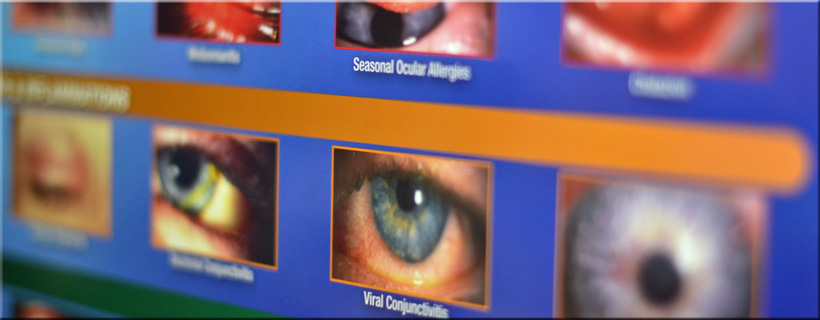
Conjunctivitis
Conjunctivitis is inflammation of the conjunctiva, the transparent tissue that lines the inner surface of the eyelid and covers the white part of the eye.
Conjunctivitis, often called “pink eye,” is common and may affect one or both eyes.
Some forms are contagious and others are not. If redness is accompanied by significant pain, light sensitivity, vision changes, or contact lens wear, prompt evaluation is important.
Read Article »
Strabismus (Crossed Eyes)
Crossed eyes, or strabismus as it is medically termed, is a condition in which both eyes do not look at the same place at the same time.
It occurs when an eye turns in, out, up or down and may be related to eye muscle control problems, nerve problems, or focusing issues such as uncorrected farsightedness.
Read Article »
Diabetic Retinopathy
Diabetic retinopathy is a condition occurring in persons with diabetes, which causes progressive damage to the retina,
the light sensitive lining at the back of the eye.
It is a serious sight-threatening complication of diabetes.
Read Article »
Dry Eye
Dry eye is a condition in which there are insufficient tears to lubricate and nourish the eye.
Tears are necessary for maintaining the health of the front surface of the eye and for providing clear vision.
People with dry eyes either do not produce enough tears or have a poor quality of tears.
Dry eye is a common and often chronic problem, particularly in older adults.
Read Article »
Farsightedness (Hyperopia)
Farsightedness, or hyperopia, as it is medically termed, is a vision condition in which distant objects are usually seen clearly,
but close ones do not come into proper focus.
Farsightedness occurs if your eyeball is too short or the cornea has too little curvature, so light entering your eye is not focused correctly.
Read Article »
Floaters and Spots
Spots (often called floaters) are small, semi-transparent or cloudy specks or particles within the vitreous, which is the clear,
jelly-like fluid that fills the inside of your eyes.
They appear as specks of various shapes and sizes, threadlike strands or cobwebs.
Because they are within your eyes, they move as your eyes move and seem to dart away when you try to look at them directly.
Sudden new floaters, flashes of light, or a curtain-like shadow in your vision can be warning signs that need urgent eye care.
Read Article »
Glaucoma
Glaucoma is a group of eye disorders leading to progressive damage to the optic nerve, and is characterized by loss of nerve tissue resulting in loss of vision.
The optic nerve is a bundle of about one million individual nerve fibers and transmits the visual signals from the eye to the brain.
The most common form of glaucoma, primary open-angle glaucoma, is often associated with increased pressure inside the eye, but glaucoma can also occur when eye pressure is not elevated.
Read Article »
Keratoconus
Keratoconus is a vision disorder that occurs when the normally round cornea (the front part of the eye) becomes thin and irregular (cone) shaped.
This abnormal shape prevents the light entering the eye from being focused correctly on the retina and causes distortion of vision.
Read Article »
Lazy Eye (Amblyopia)
Lazy eye, or amblyopia, is reduced development of clear vision in one eye, or sometimes both eyes, during childhood.
It can result when the brain and eyes are not working together properly.
Amblyopia is often associated with crossed eyes or a large difference in prescription between the two eyes, and it usually develops in early childhood.
Read Article »
Macular Degeneration
Age-related macular degeneration (AMD) is an eye disease that affects the macula, the part of the retina responsible for sharp central vision.
It is a leading cause of vision loss in older adults, and early AMD may not cause symptoms.
Read Article »
Myopia (Nearsightedness)
Nearsightedness, or myopia, as it is medically termed, is a vision condition in which close objects are seen clearly, but objects farther away appear blurred.
Nearsightedness occurs if the eyeball is too long or the cornea, the clear front cover of the eye, has too much curvature.
As a result, the light entering the eye isn’t focused correctly and distant objects look blurred.
Read Article »
Nystagmus
Nystagmus is a vision condition in which the eyes make repetitive, uncontrolled movements, often resulting in reduced vision.
These involuntary eye movements can occur from side to side, up and down, or in a circular pattern.
As a result, both eyes are unable to hold steady on objects being viewed.
Nystagmus may be accompanied by unusual head positions and head nodding in an attempt to compensate for the condition.
Read Article »
Ocular Hypertension
Ocular Hypertension is an increase in the pressure in your eyes that is above the range considered normal with no detectable changes in vision
or damage to the structure of your eyes.
The term is used to distinguish people with elevated pressure from those with glaucoma,
a serious eye disease that causes damage to the optic nerve and vision loss.
Read Article »
Presbyopia
Presbyopia is a vision condition in which the crystalline lens of your eye loses its flexibility, which makes it difficult for you to focus on close objects.
Read Article »
Retinitis Pigmentosa
Retinitis Pigmentosa (RP) is a group of inherited diseases that damage the light-sensitive rods and cones located in the retina, the back part of our eyes.
Rods, which provide side (peripheral) and night vision are affected more than the cones that provide color and clear central vision.
Read Article »
Retinoblastoma
Retinoblastoma is a rare eye cancer that develops in the retina and most often occurs in young children.
Prompt diagnosis and treatment are important to protect vision and overall health.
Read Article »
Uveitis
Anterior uveitis is inflammation involving the iris and adjacent tissue inside the eye.
If untreated, it can lead to complications such as glaucoma, cataract, retinal swelling, and permanent vision loss, so prompt evaluation is important.
Read Article »
From information to care
Comprehensive eye examinations
Some eye diseases have few early symptoms. Learn what Optima evaluates during a comprehensive eye exam.
Evaluation, treatment, and referral
Review the practice's approach to eye-condition evaluation and treatment, including referral when specialist or surgical care is needed.
Sources and review status
This page received an informational editorial review using the American Optometric Association articles linked with each condition and
National Eye Institute eye-health information.
The review is not a clinical review or endorsement by an Optima Optometry clinician.